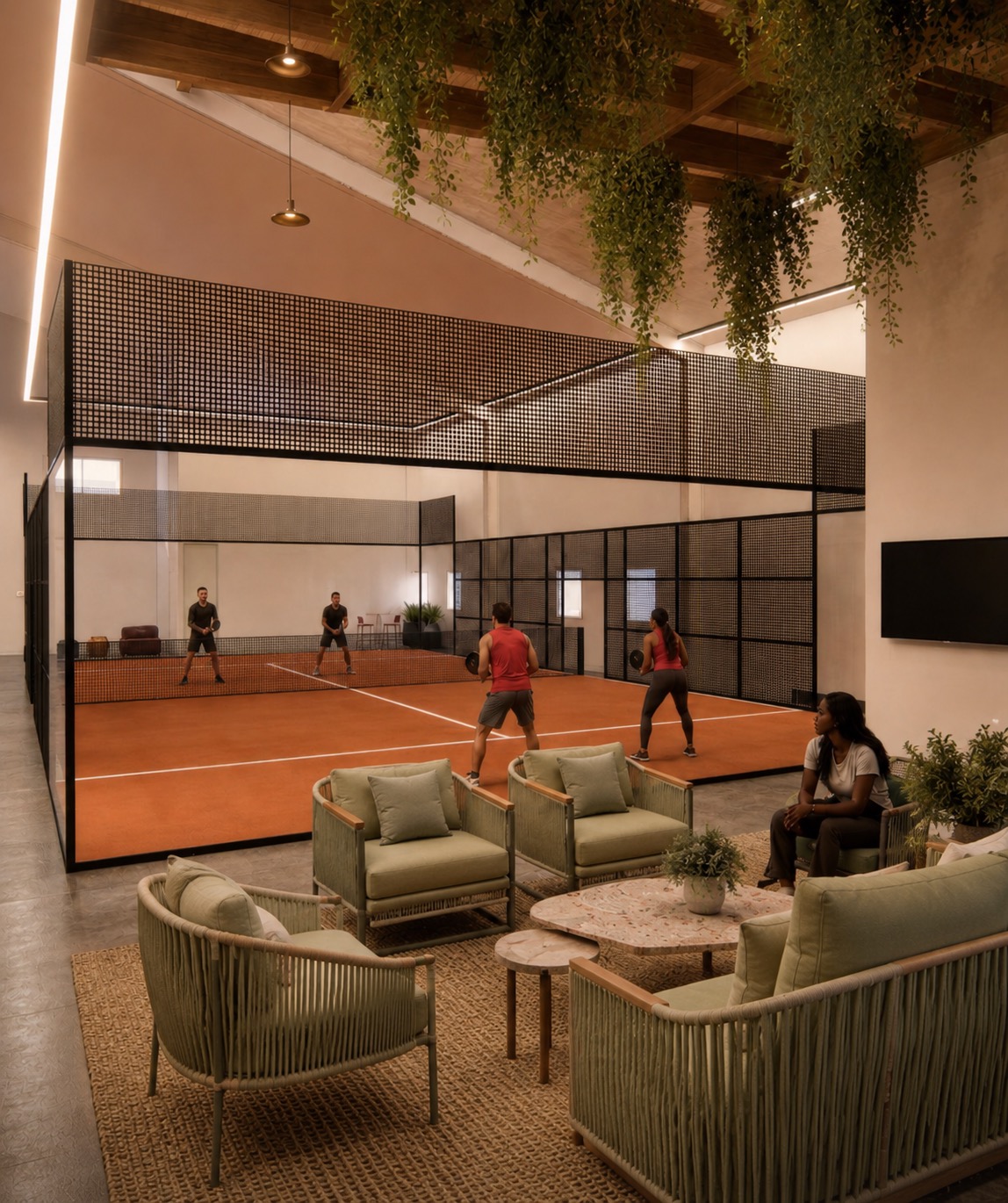
Padel in Austin, a starting guide
What the game is, what a first session actually costs, and why the good ones are indoors from June to September
What the game is, what a first session actually costs, and why the good ones are indoors from June to September
Padel is a doubles racket sport played on an enclosed court roughly a third the size of a tennis court. The walls are glass and they are in play, the serve goes underhand, and the racket is a solid perforated paddle with no strings. Four people, one court, ninety minutes
The reason it travels so well is that the barrier to a good first game is almost nothing. The underhand serve removes the single hardest skill in tennis. The short court means you are never sprinting corner to corner. And because the ball comes off the back glass, the rally keeps going long after it would have died on an open court. Most people who have never held a padel racket are having real rallies inside ten minutes
It is the fastest growing racket sport in the world, and Austin has quietly become one of the densest padel cities in the United States per capita
Austin already had the ingredients. A tennis and pickleball habit, a population that moves outdoors by default, and a steady arrival of people from Europe and Latin America who grew up with padel as a normal weekend. The clubs followed, and the city now supports a real scene across North Austin, East Austin, the Domain area, and out toward Dripping Springs
What makes padel stick here specifically is the social shape of it. It is always doubles, so you cannot play alone, and the skill gap between a beginner and a regular matters less than in almost any other racket sport. A group of four with wildly different backgrounds still gets a good game. That is a rare thing, and it is why padel courts in Austin tend to fill with the same faces week after week
Padel is played as doubles. If you do not have a group, open play sessions and player matching exist at most Austin clubs
The standard court block. Priced per court, not per person, so four people split one fee
Rackets and balls rent at the desk. Flat soled shoes and water are all you need to bring
About how long it takes a first timer to start rallying properly. The walls are forgiving
Austin gives you about eight beautiful months of outdoor padel and four months where a 2pm game is a genuinely bad idea. From June through September, outdoor courts get booked at 7am and 8pm and sit empty in between, which is exactly when most people are free
Indoor, air conditioned courts solve the part of the year that otherwise quietly kills the habit. No heat advisory, no rain check, no rescheduling a doubles group four ways because a storm rolled in off the Hill Country. The court is the same temperature in August as it is in February, and your Tuesday game survives the summer
It matters more than it sounds. Padel is a habit sport, and habits break when the venue becomes unreliable. Climate control is not a luxury feature in Central Texas, it is what makes year round play possible
The best setup is having both. Indoor courts for the summer and for weather, outdoor courts for the spring and fall evenings when playing under an open Austin sky is the entire point. The Padel Collective has five indoor air conditioned courts, and four outdoor courts and a full patio arrive later in 2026
Book a court for four, or turn up to an open play session and get matched. Wear flat soled court shoes, running shoes will do for a first try but they roll on the lateral movement. Rent a racket at the desk rather than buying one, because the paddle you want after a month is not the paddle you would pick on day one
Austin clubs price by the court, not the head. A ninety minute block generally runs somewhere between forty and eighty dollars depending on the club and the hour, which is roughly ten to twenty dollars each once four of you split it. Racket rental is usually a few dollars on top. If you end up playing weekly, a membership brings the per game number down considerably, which is the point at which most people stop counting
No. Padel is one of the easiest racket sports to start. The underhand serve removes the hardest skill in tennis, the short court keeps rallies alive, and the walls give you a second chance at almost every ball. Tennis and pickleball players pick it up immediately, and complete beginners are usually rallying within one session
Clubs here price courts by the ninety minute block rather than per person, so a group of four splits one fee. Expect roughly forty to eighty dollars for the court depending on the club and the time of day, which is about ten to twenty dollars each. Rackets rent for a few dollars, and memberships bring the per game rate down
Four. Padel is always doubles, two against two. If you do not have a group, most Austin clubs run open play sessions and match players by level, so turning up alone is completely normal
No. They look similar from a distance and both are easy to start, but padel is played on a larger enclosed court with glass walls that keep the ball in play, uses a ball closer to a tennis ball, and is always doubles. Rallies run longer and the movement is closer to tennis
Flat soled court shoes, comfortable clothes, and water. That is the whole list. Rackets and balls are available to rent, so there is no reason to buy equipment before you know you like the game
Indoors, yes, comfortably. Air conditioned courts are what keep a midday game playable from June through September. Outdoor courts are excellent for the other eight months of the year
1610 Dungan Ln, Austin, TX 78754, in North Austin near the Braker and Dessau corridor, with easy access from I-35 and 183. We open with five indoor air conditioned courts, a Revolución café, a Finnish sauna with cold plunges, a fitness room, co-working, and EV charging. Four outdoor courts and the full Oasis patio follow later in 2026
Yes, we are open. Book a court on Playtomic, or come by and see the Oasis for yourself. New to the club? Here is how to play here, from your first booking to open play
Founding rates, first access to court times, and the invitations we do not post publicly. No noise, we email when there is something worth saying
Book a court